Guest post from Lawrence Goldstone:
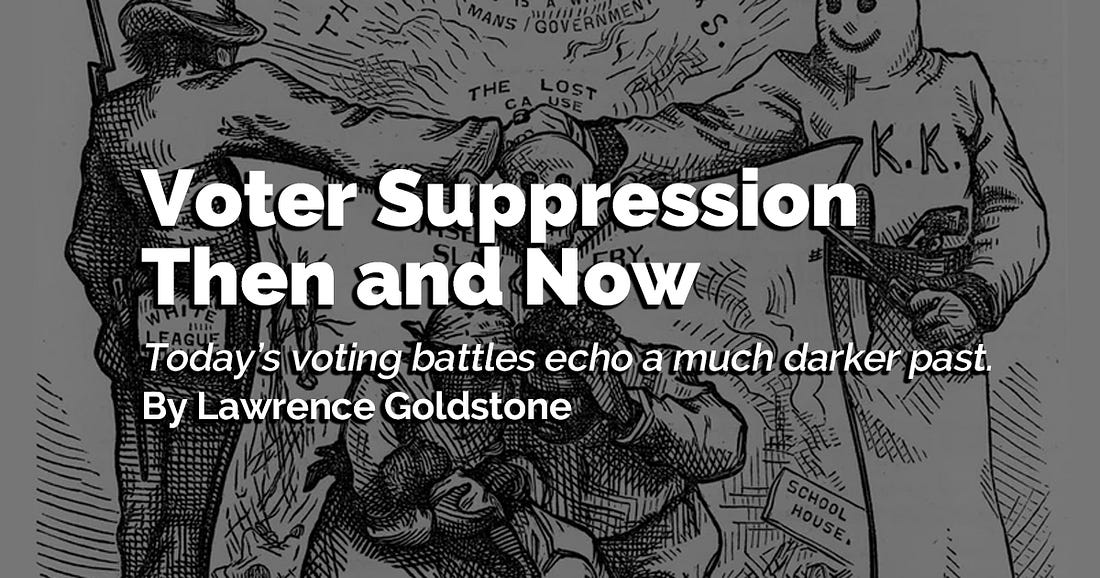
It would not be unreasonable to conclude that the current assault on voting rights, which, as always, falls heaviest on Black Americans, is so pervasive, so blatant, so hypocritical, that conditions never have been worse. But they were worse. Much worse. In the years following the Civil War, with the ratification of the 14th and 15th Amendments and the Union army stationed throughout the defeated Confederacy, many thousands of former slaves, known as “freedmen,” not only registered to vote, but were elected to local and state offices, and even to the United States Congress. White supremacists, called “Redeemers,” were determined to reclaim power and return the South to as near a replication of the slave system as possible. This could only be achieved by retaking control of state and local governments, which meant eliminating the Black vote. Their crusade had three main phases, each of which set the stage for the next. The first was terror. The army was stationed primarily in the cities. In the countryside, groups such as the Kuklux regularly employed beatings, murders, house burnings, and violation of Black women to intimidate potential voters. There were efforts to end the violence, as in 1869 when President Grant established the Department of Justice specifically to end a reign of terror in South Carolina, but these were only marginally successful. The biggest impediment to enforcement was the Supreme Court, which was always there to lend a helping hand to white supremacists. In a series of decisions, it ruled that the 14th Amendment only provided protection against government action, thereby granting virtually full immunity to attacks against Black Americans, which could only be prosecuted under state law. There were direct attacks as well. In his 1873 circuit court opinion in United States v Cruikshank, Associate Justice Joseph Bradley wrote, “The Fifteenth Amendment confers no right to vote. That is the exclusive prerogative of the states. It does confer a right not to be excluded from voting by reason of race, color or previous condition of servitude, and this is all the right that Congress can enforce.” Bradley’s legal two-step shifted the burden of proof from the state to establish that it had not discriminated — to an individual to prove that it had. The Court subsequently ruled that an appellant must further demonstrate that the state’s action was motivated only by race, which proved an almost impossible task. Still, showing incredible courage, many Black men continued to vote, and Redeemers eventually decided that if they could not stop the voters, stop the votes. Ballot boxes were stuffed and legitimate votes destroyed. Ironically, introduction of the secret ballot made fraud much easier to perpetrate, since no one could prove that vote counts were faked. Redeemers eventually grew queasy. A Mississippi judge named J. J. Chrisman observed, “It is no secret that there has not been a full vote and a fair count since 1875. In plain words, we have been stuffing the ballot boxes, committing perjury, and…carrying the elections by fraud and violence until the whole machinery for elections was about to rot down.” Taking a cue from the 14th and 15th Amendments, which used the federal Constitution to guarantee equal rights, Redeemers decided to use state constitutions to guarantee unequal rights. In 1890, Mississippi became the first to hold a constitutional convention for the express purpose of legally denying the vote to Black Americans. Whites made little secret of their intent. James K. Vardaman, later elected as both governor and United States senator, observed later, “There is no use to equivocate or lie about the matter. Mississippi’s constitutional convention of 1890 was held for no other purpose than to eliminate the n***** from politics…let the world know it just as it is.” Thanks for reading! Subscribe for free to stay sharp, fight back, and never miss a beat in the battle for democracy. The result was a new state constitution replete with contrivances that would become standard across the South. These included literacy tests, in which Black men were given impossible passages to read; poll taxes; phony “vagrancy” prohibitions; a grandfather clause that automatically registered whites whose fathers or grandfathers had fought in a war or voted previously; and strict landholding, residency, or property tax requirements. Although virtually every Black voter was purged from the rolls, the Supreme Court once again chose to deny the obvious. In Williams v Mississippi, it ruled that, “The Constitution of Mississippi and its statutes do not on their face discriminate between the races, and it has not been shown that their actual administration was evil; only that evil was possible under them.” But the worst of these decisions was rendered in 1903 by that revered champion of civil liberties, Oliver Wendell Holmes, Jr. In Giles v Harris, which challenged the 1901 Alabama constitution, he admitted “the whole registration scheme is a fraud upon the Constitution of the United States.” But, he went on, if the Court ruled in Giles’s favor, it would become “a party to the unlawful scheme by accepting it and adding another voter to its fraudulent lists.” Alabama’s “fraudulent” constitution was thus allowed to stand. To follow this absurd reasoning, any law that was discriminatory would be a “fraud,” and the Court would become party to that fraud by protecting any plaintiff’s right as a citizen. (In the same opinion, he wrote that the Court should not adjudicate political issues, a principle now liberally employed to justify even the most egregious cases of gerrymandering.) These decisions eliminated legal recourse. It became impossible for a Black man, and eventually woman, to register to vote. The effect was devastating. By 1906, 83% of white males in the South were registered to vote, compared to 2% of blacks. And into that vacuum was sucked the horrors of Jim Crow. Nonetheless, with unflagging fortitude, audacity, and the efforts of brilliant lawyers like Charles Houston and his protégé, Thurgood Marshall, activists began to chip away. The grandfather clause was ruled unconstitutional in 1915, other provisions were voided, and poll taxes were abolished by the 24th Amendment. The crowning achievement was passage of the Voting Rights Act in 1964. Finally, it seemed as if the right to vote might actually be guaranteed to all Americans. But no, the Supreme County again leapt into the breach to save white supremacy. In decisions such as Shelby County v Holder, and Brnovich v DNC, the justices whittled down the Voting Rights Act, which they will perhaps do even more in Callais v Louisiana. Still, although thanks to Justice Holmes, gerrymandering will remain an immense, ongoing challenge, many tools once cornerstones of voter suppression are now unavailable. (Donald Trump’s proposed executive order on elections is almost certain to be non-starter, even with this Court.) Everything that is left can only make voting more difficult, more inconvenient, and more frustrating…but not impossible. If those we have come to revere refused to be deterred in overcoming the impossible, we can show equal perseverance in overcoming the difficult, the inconvenient, and the frustrating. Lawrence Goldstone has written more than a dozen books and numerous articles about American history, contemporary politics, and Constitutional law. One of his novels won a New American Writing Award, another was a New York Times notable mystery. His work has been profiled in The New York Times, the Toronto Star, Salon, andSlate, among others. Paid for by Fair Fight, www.fairfight.com, not authorized by any candidate or candidate’s committee.
|

EXPERIENCE THE JOURNEY OF... KIM, TIM AND MOLLY MYERS AS THEY TRAVEL TO CHINA TO BRING HOME ANNIE!
Friday, March 13, 2026
Voter Suppression Then and Now






Subscribe to:
Post Comments (Atom)
No comments:
Post a Comment
Note: Only a member of this blog may post a comment.