

Israel-Backed Palestinian Militias Terrorize Displaced Families in GazaOver the past year, attacks by Israel-backed Palestinian militias have become increasingly frequent in Gaza, particularly targeting Palestinians living close to the ever expanding “yellow line.”
Drop Site is a reader-funded, independent news outlet. Without your support, we can’t operate. Please consider becoming a paid subscriber or making a 501(c)(3) tax-deductible donation today.
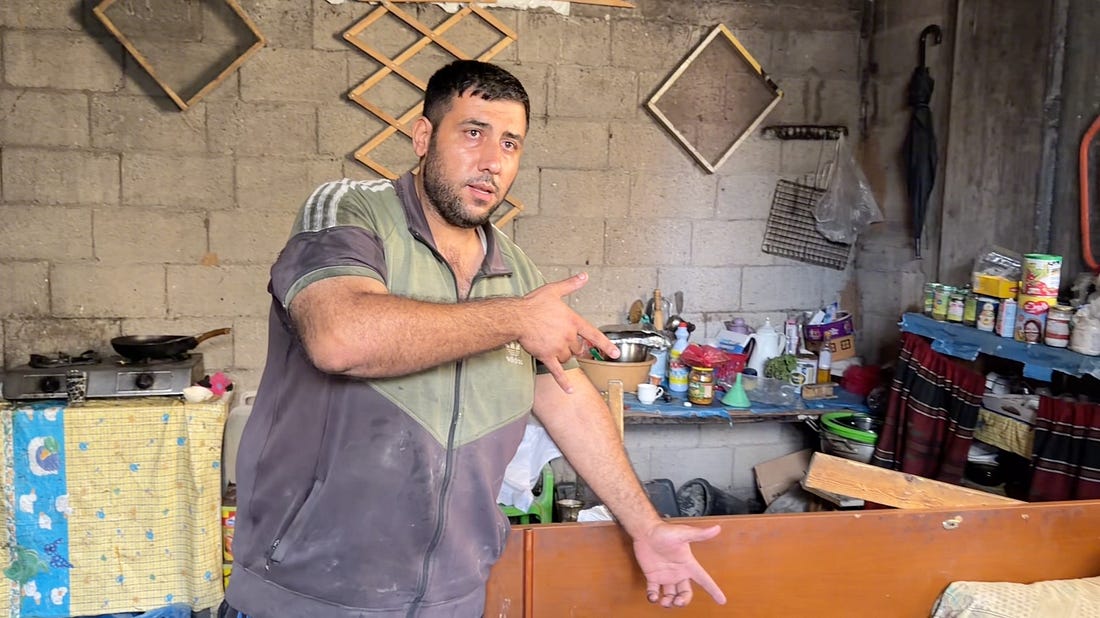
JABALIYA REFUGEE CAMP, Gaza Strip—Youssef Al-Sheikh was asleep with his wife and eight young children in a room on the ground floor of a badly damaged building in the wasteland of northern Gaza’s Jabaliya refugee camp when the group of masked, heavily armed members of an Israeli-backed Palestinian militia broke down the door and stormed inside. It was around 2 a.m. on the night of September 24. Decked out in tactical gear and with their assault rifles pointing menacingly down at his family, they began shouting at Al-Sheikh to get up. The light from their military headlamps pierced the darkness, blinding Al-Sheikh. “They came inside, and as soon as they entered, one of them raised his Kalashnikov and aimed it at me while I was here,” Al-Sheikh told Drop Site News, pointing to the only bed in the room, made up of thin mattress laid on a thin piece of wood propped up on concrete blocks. “About seven people came in. They all had flashlights on them—bright white lights, extremely powerful flashlights,” he said. “With all the white light, I couldn’t see who was in front of me.” The lead gunman started yelling “Qassam,” Al-Sheikh said, a reference to the Izz al-Din al-Qassam Brigades, the military wing of Hamas. “He said, ‘Why are you staying here? Where are the explosive devices you have? Where are the weapons you have?’” Al-Sheikh recalled. “I told him, ‘I’m a peaceful citizen. I don’t have anything.’” When Al-Sheikh asked if could put some clothes on, the militiamen grabbed him and began savagely beating him in front of his wife and children. “I couldn’t process what was happening and didn’t know what to do,” Al-Sheikh said. “Three of them came at me, punching and slapping me and beating me. They beat me in the most brutal ways.” Angry red bruises were still visible on his neck and back two days later. They bound Al-Sheikh’s hands behind his back and left him on the ground. Amid the commotion, one of Al-Sheikh’s brothers-in-law entered from the room next door, pleading with the men to have mercy. “They grabbed him by his hair. Three of them attacked him, threw him to the ground, and beat him with their Kalashnikovs,” Al-Sheikh said. When a second brother-in-law arrived, they also grabbed him and beat him with their rifle butts. The militiamen took the three men into an adjacent room and made them kneel on the floor. What appeared to be the lead gunman pulled up a chair and sat in front of them. One of Al-Sheikh’s brothers-in-law, Muatasim Al-Aja, had his hands bound and his mouth gagged. The other, Hossam Tafesh, also had his hands bound. The militiamen pulled out a black T-shirt from Tafesh’s belongings and accused him of being a part of the resistance. When Tafesh said he had nothing to do with the resistance, they began beating him again and wrapped the T-shirt tightly around his face until he began to suffocate. The other militiamen ransacked the rest of the house, going through and overturning the family’s scant belongings and confiscating all the phones they could find. “One of my children was inside the room while this was happening and he started slapping himself. He’s a little boy, a very young child,” Al-Sheikh said. “He kept slapping himself across the face, crying, ‘Dad, Dad, Dad! Where’s my dad?’ The officer told my wife, ‘Either you shut the children up—all of you be quiet—or I’ll shoot them all and kill them.’” 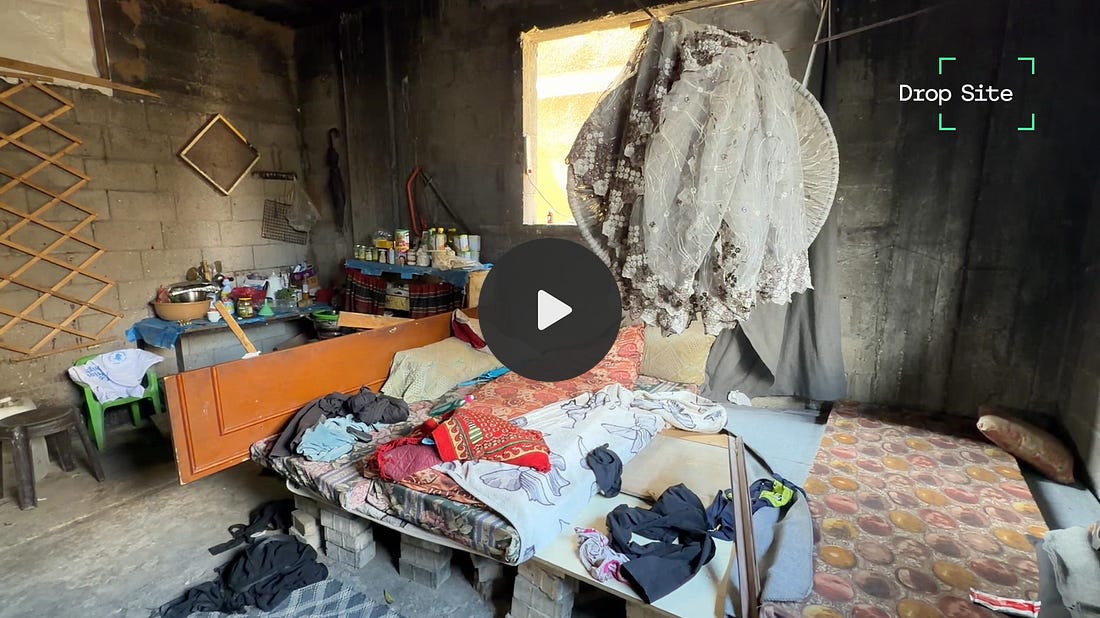
Youssef Al-Sheikh in his home in the Jabaliya refugee camp in northern Gaza that an Israel-backed Palestinian militia raided last month, beating him and his relatives and detaining one of them. September 26, 2026. Video by Abdel Qader Sabbah.Al-Sheikh said he later learned from eyewitnesses that an even larger militia force of close to 30 heavily armed men was surrounding the house outside. “It was as if an entire battalion had come to fight us,” he said. Eventually, the lead militiaman made Al-Sheikh and both of his brothers-in-law look into his phone camera and photographed their faces. “He photographed us and sent the pictures over WhatsApp,” Al-Sheikh said. Several minutes later, the gunman received a call and announced they could be released. At the same time, several gunmen went upstairs and detained a third brother-in-law, Said Okasha, who had gone up to the roof in fear. “They started beating him. We could hear the blows and the screaming. He was shouting, ‘Leave me! Leave me!’ They restrained him and took him away in his underwear,” Al-Sheikh said. “They took him and left.” Two other residents in the area interviewed separately confirmed to Drop Site that a raid by a Palestinian militia had taken place that night. “No One Comes to Help Us”Over the past year, since a “ceasefire” agreement went into effect, attacks by Israel-backed Palestinian militias have become increasingly frequent in Gaza, particularly targeting Palestinians living close to the “yellow line”—the demarcation of Israel’s line of control that runs north to south along the Gaza Strip roughly parallel to the coastline. Israel has also imposed another boundary called the orange line, which in some places encroaches more than 1 kilometer beyond the yellow line, taking over even more Palestinian land. On the western side of these lines, virtually the entire Palestinian population of Gaza has been corralled into an ever shrinking space. On the eastern side, the Israeli military has violently reconfigured the landscape, razing the area to the ground and building dozens of fortified bases and roads—establishing a permanent presence instead of preparing for a phased withdrawal as outlined in the ceasefire agreement. Israeli forces regularly bomb, shell, and shoot Palestinians on the western side in violation of the “ceasefire,” killing over 1,500 men, women, and children over the past 12 months. The Israeli military has also armed and equipped several Palestinian militias that operate on the ground, conducting raids and terrorizing people mostly living close to the yellow line. Large scale raids are conducted in coordination with the Israeli military, who have backed them up with artillery and aerial support. Many of the militia leaders in Gaza who rose to power in collaboration with Israel during the genocide are former gang leaders with a history of criminal activity, were associated with jihadi groups, or are former Palestinian Authority security forces that were all sidelined after Hamas gained control of the enclave in 2007. At least five of these militias are operating out of compounds in areas under Israeli military control across the Gaza Strip, according to satellite imagery and videos published online. While Drop Site could not confirm which militia raided Al-Sheikh’s house last month, the location of the building in the Jabaliya refugee camp is geographically closest to the northernmost militia compound in Gaza, located in Beit Hanoun, that is run by the Northern Forces, also known or the Popular Army. According to a report by Al-Zaytouna Center for Consultations & Studies, the Northern Forces Forces/Popular Army was established in September 2025 and is led by Ashraf al-Mansi, who was previously accused of drug smuggling and other charges. The militia is made up of several dozen armed members and claims control over Jabaliya. The building where Al-Sheikh and his family have been sheltering is next to the Jabaliya Services Club, a Palestinian sports club founded in the Jabaliya refugee camp by the UN Palestinian refugee agency—UNRWA—in the 1950s. The club was destroyed by Israeli occupation forces during the genocide and was briefly turned into a military barracks and interrogation center during Israel’s ground invasion of Jabaliya in October 2024. Israeli forces eventually withdrew to the nearby yellow line following the ceasefire a year later. Now, a few dozen displaced Palestinian families have sought shelter in and around the badly damaged sports club. The area has been turned into a gray moonscape through intense Israeli bombing and demolition, with mounds of rubble and destroyed buildings where a densely crowded urban landscape once stood. At the yellow line in the near distance, Israeli bases perched atop a massive earthen berm are clearly visible, with tall red and white communication towers protruding into the sky and a large Israeli flag billowing in the wind. Residents of the area describe a complete lack of food and water or any services, combined with frequent attacks by Israeli forces and collaborating Palestinian militias. 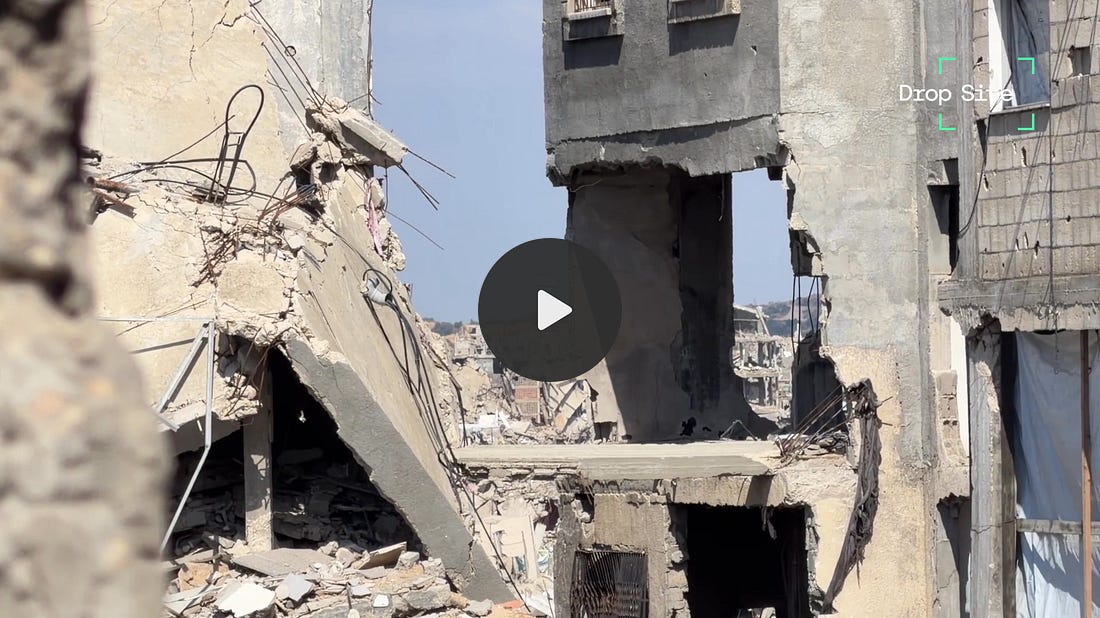
The area near the Jabaliya Services Club in northern Gaza near the yellow line is completely destroyed with no access to food or water and frequently subject to attacks by Israeli forces and Palestinian militias. September 26, 2026. Video by Abdel Qader Sabbah.“There is basically no life here. We don’t have enough water. There is indiscriminate gunfire 24 hours a day, as well as quadcopter fire and shelling. People are living with almost nothing,” Ahmad Hammad, a displaced resident in the area told Drop Site. As he spoke, the crackle of machine gun fire punctuated the air. “As you can see, everything is rubble and debris. Rodents are everywhere. Heavy gunfire is almost a daily occurrence. It’s a tragedy. No one comes to help us at all.” It is in areas like this in Gaza, close to the Israeli line of control, where Palestinian militias operate most frequently. “Water trucks can’t reach us, so we have to walk a long distance to get water,” Safaa Al-Basyouni, a local resident, told Drop Site. “No food from charity kitchens reaches us at all. Shrapnel from Israeli fire falls around us. So we face danger from the Israelis, and on top of that, danger from the militias.” The majority of Palestinians in Gaza live in dense, squalid tent encampments that are infested with rodents and insects and provide little protection from the elements. Al-Basyouni and others came to the Jabaliya Services Club to try and find better shelter. “We thought sheltering under concrete would be better than sheltering under a tent. That’s what brought us here,” she said. “But it was all for nothing. We still found insects here, and we found gunfire and shelling too. We don’t know where to go. We came here hoping it would be better, but in reality, it turned out to be worse.” “Our situation here, so close to the yellow line, is tragic,” Al-Basyouni continued. “We can’t hide from the Israelis, and we can’t hide from the militias.” While Israeli forces have taken to shooting, shelling, and bombing Palestinians from afar on a regular basis, the Palestinian militias are deployed to raid areas on the ground. “The militias are constantly around here, and we’re afraid of them. Suddenly, you find them surrounding the area with quadcopters, opening fire at us, and storming inside,” Arafat Ali, who was displaced to the Jabaliya Services Club, told Drop Site. “Day and night, you find them coming in and attacking us. They recently beat four young men and detained one of them before leaving,” he said, referring to the raid on Al-Sheikh’s house. “Even the man they detained had nothing to do with any organization.” “We don’t even understand how they operate. Suddenly, they open fire at us, fire shells, take young men captive, and then leave,” Ali continued. “They don’t come during the day. They come at three in the morning, like bandits.” There is no reliable count of how many people have been detained by Palestinian militias. Like many others, Said Okasha, Al-Sheikh’s brother-in-law who was detained in the raid last month, is most likely imprisoned in one of Israel’s detention camps where torture and abuse is systemic. Meanwhile, Al-Sheikh himself has struggled to come to terms with the violence of the raid. “It was truly horrific—more horrific than you can imagine. Even now, speaking personally, apart from what this has done to my wife and children, what happened to me has left me hysterical and hallucinating. I walk down the street and tears start falling on their own,” he said. “No matter how much I describe the scene, I can’t truly convey what it was like.” March of the Yellow LineThe yellow line that Israeli troops initially withdrew to as part of the ceasefire agreement in October 2025 gave them control of 53% of the eastern side of the Gaza Strip, as outlined on Israel’s own military maps. In some places, the line is demarcated by yellow concrete blocks, but in most of Gaza the boundary is invisible. Since then, Israeli forces have steadily pushed in, driving Palestinians further west, and expanding their control to close to 70% of the enclave. Last week, Israeli troops moved further into Shujaiya, once a vast, densely populated neighborhood in eastern Gaza City. On October 11, displaced Palestinians who sought shelter in the area woke up to shooting and shelling by Israeli forces as they moved the yellow blocks some 200 meters further inward, sparking panic and another round of displacement. “The yellow line used to be approximately 200 meters away from us. This morning, it was only 10 meters away,” Osama Mushtaha, 50, told Drop Site. 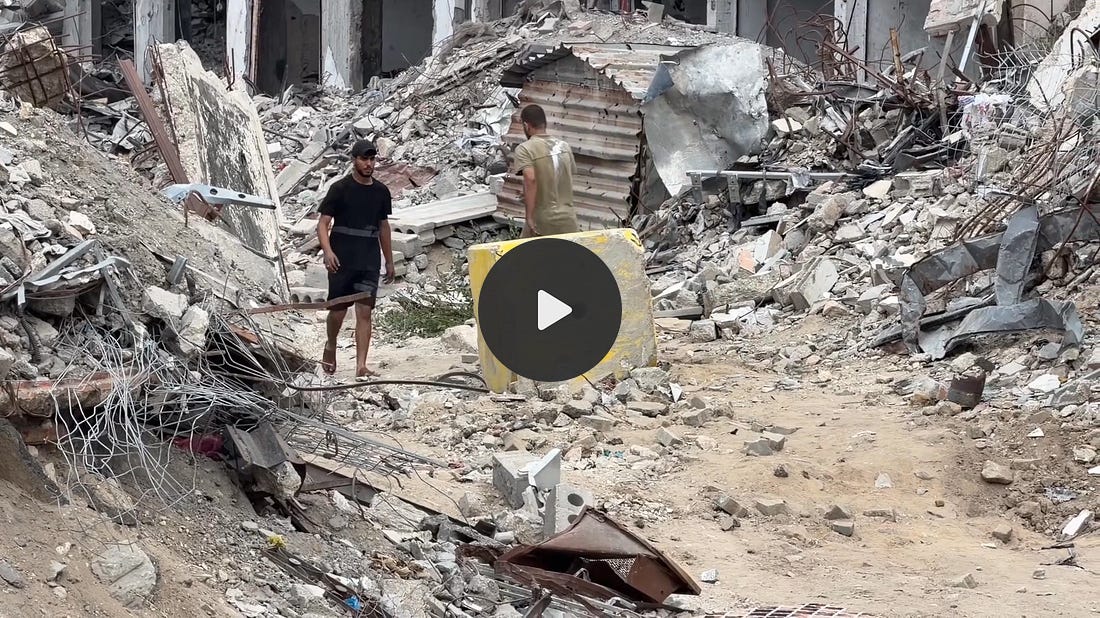
Families in Shujaiya in eastern Gaza City are forced to flee following an attack by Israeli forces as they moved yellow blocks into the area, further expanding Israel’s line of control. October 11, 2026. Video by Mohamed Ahmed.Throughout the day, exhausted families gathered their scant belongings, piling mattresses and bags on the dusty streets, forced to flee once again in a desperate search for shelter. “We’re dying here every day because of the yellow line,” Anis Herzallah, 30, said. “At night we have shelling, quadcopters, tanks, Apaches and F-16s—all of them attacking us from the yellow line. We can’t live here anymore. “ The blocks in Shujaiya now lie close to Salah Al-Din street, a historic thoroughfare running north to south along the length of the Gaza Strip. Every encroachment of the yellow line brings Israel troops and the collaborating Palestinian militias ever closer. “People are leaving, not knowing where they’re supposed to go,” a passerby said. “An Israeli tank and bulldozer advanced towards the area. They also have militias with them.” Sara Al-Ramlawi, 33, has been displaced with her family repeatedly over the past three years, moving from one place to another every few months before arriving at Shujaiya several months ago, only to be driven away yet again. “We were forced out because they moved the yellow line closer, we have suffered so much,” she told Drop Site. “We’re heading into the unknown. This is our situation, and the situation of every family from Shujaiya living here.” “We’re not asking for a house. Just a piece of land where we can put up tents.” Mohamed Ahmed and Jawa Ahmad contributed to this report. Sami Vanderlip edited the video. Become a Drop Site News Paid SubscriberA paid subscription gets you:✔️ 15% off Drop Site store ✔️ Access to our Discord, subscriber-only AMAs, chats, and invites to events, both virtual and IRL ✔️ Post comments and join the community ✔️ The knowledge you are supporting independent media making the lives of the powerful miserable You can also now find us on podcast platforms and on Facebook, Twitter, Bluesky, Telegram, and YouTube.
|







No comments:
Post a Comment
Note: Only a member of this blog may post a comment.