

The Crimson Thread: The Israeli Military Barrier Cutting Off Palestine’s BreadbasketThe first 22 kilometers of a planned 500-kilometer Israeli military barrier are cutting off Palestinians from a large swathe of some of the most fertile agricultural land in the occupied West Bank.
Drop Site is a reader-funded, independent news outlet. Without your support, we can’t operate. Please consider becoming a paid subscriber or making a 501(c)(3) tax-deductible donation today. 
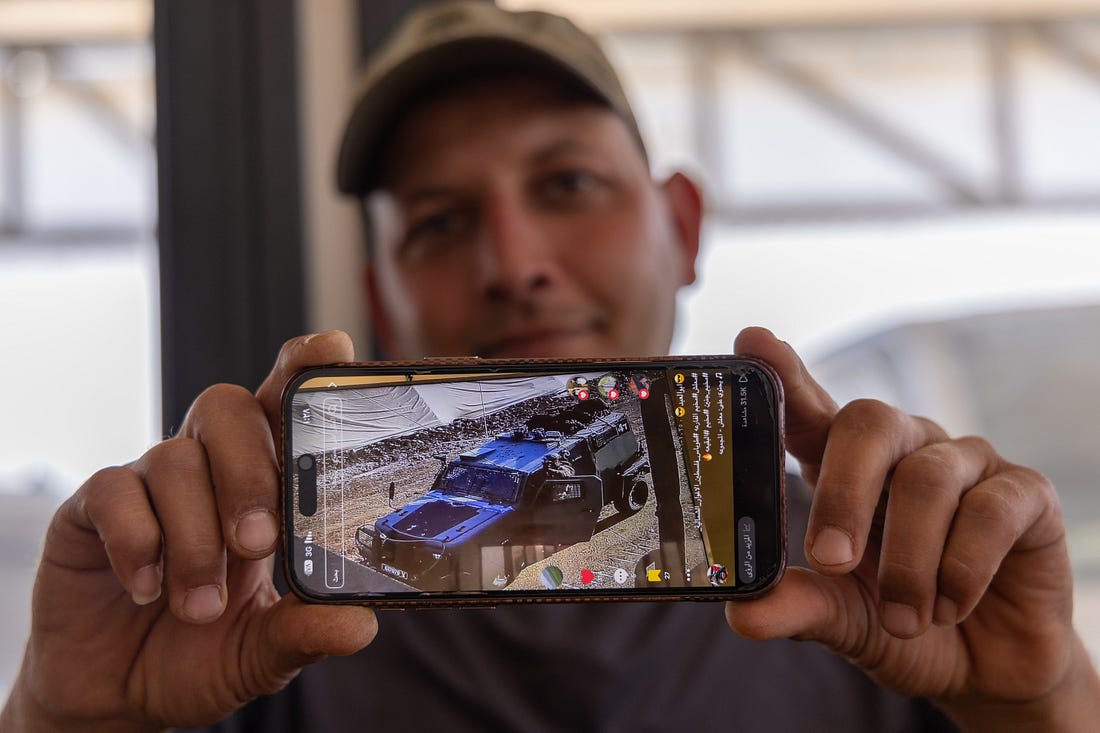
TUBAS, West Bank—Muad Abdelreziq walked slowly through his land on the Al-Forat farm, meandering through rows of banana groves on foot, checking each tree for signs of life. The dead leaves crunched underfoot with each slow, defeated step. No water had reached these groves in five days. “These bananas, they are thirsty,” he said. “They are withering away on the ground.” “Everything on the land lives day by day.” Israel had not allowed water to reach 400 dunams (roughly 100 acres) of the farm for five days, Abdelreziq told Drop Site, and what little infrastructure remains is being destroyed. Israeli forces have been rupturing the irrigation pipelines that feed the fields. “I cannot irrigate the herbs, I cannot irrigate the melons,” he said. “I cannot replace the water lines. All these families will have nothing. We will have to stop.” Abdelreziq gripped the wheel a little tighter as he drove away from the groves toward the office on the property, glancing at the Israeli military bulldozer just a few feet away that was carving a trench deep into his land. A black military surveillance truck, complete with cameras, antennas, and sensors mounted across its roof, patrolled the site. Stepping into the workers’ room, empty chairs lined the walls where employees would take their breaks. Abdelreziq sat and stared at a screen mounted in the corner displaying a live feed of the military construction outside. The Israeli military shot down the last camera he had set up filming the site. He replaced it the next day.
The 2,000 dunam Al-Forat farm sits in the village of Khirbet Atouf, east of Tubas in the northern Jordan Valley in the occupied West Bank. The farm cultivates bananas, herbs, potatoes, onions, and melons and employs roughly 250 families, supplying markets across the West Bank—land that now sits in the path of a new 22-kilometer separation wall and military road that the army began constructing in March. Israeli settlers have also established a presence on the surrounding land. 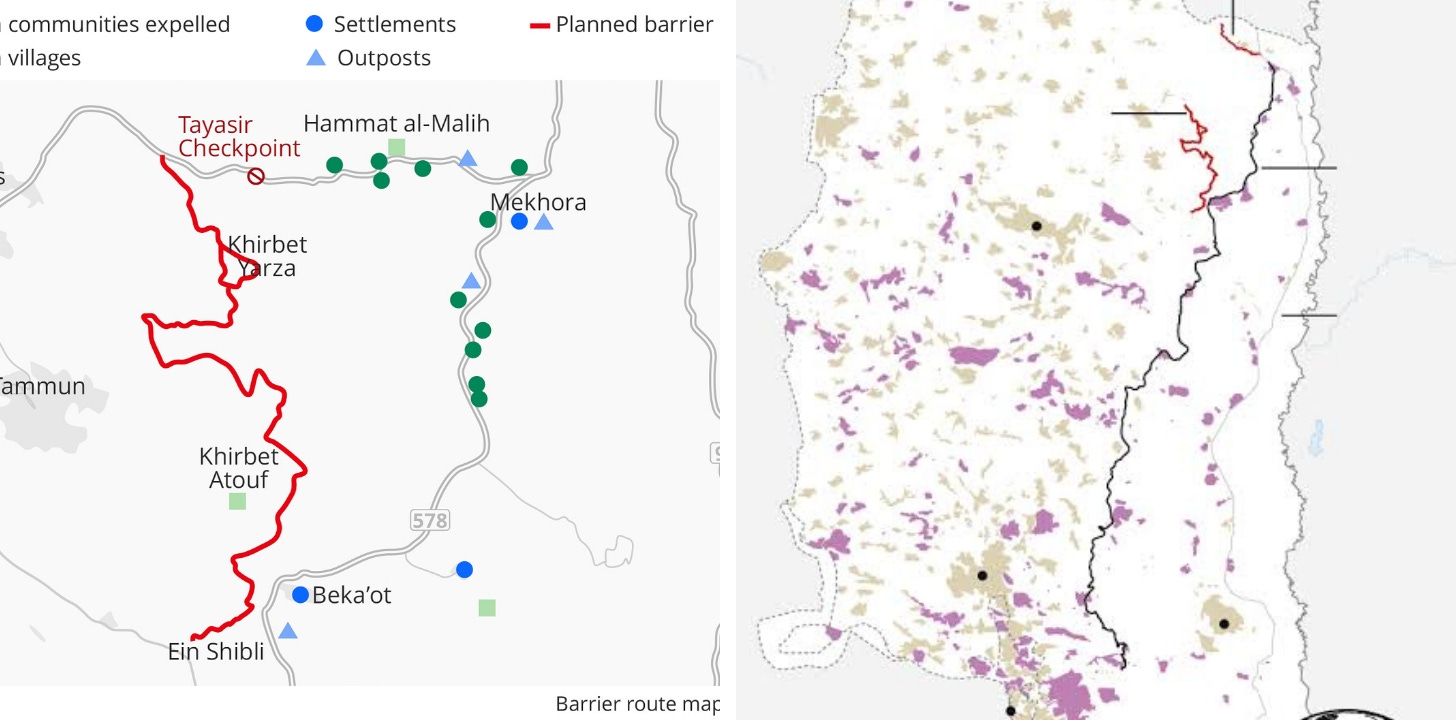
Maps showing the planned Israeli "Crimson Thread" barrier in the occupied West Bank. Courtesy: Kerem Navot.
Rasheed Khudeiri, a farmer and activist with the Jordan Valley Solidarity Campaign who has spent years documenting settlement expansion in the area, pointed out the hypocrisy of Israel’s argument, citing security concerns to displace Palestinians yet allowing Israelis settlers to live in the same area. “How is a closed military firing zone dangerous when they allow settlers who came from Russia or the United States or the Middle East?” Khudeiri told Drop Site. “The owner of the land is not allowed, and the settler is allowed.” Khudeiri says the project will cut from Ain Shibley in the central valley north to the Tayasir military checkpoint, through the communities of Hatu, Ras Al-Ahmar, Anun, and Khirbet Yarza, placing an estimated 180,000 dunams (around 44,000 acres) beyond Palestinian reach. Khudeiri says the loss will not stay confined to the residents living along the barrier but will have ripple effects that reach into every Palestinian household across the West Bank. The Jordan Valley’s fertile soil and warm climate allow farmers to grow vegetables from November through March—winter months when the rest of the West Bank gets colder and produces little to nothing. When farms like Al-Forat stop producing, prices rise across the board. A kilo of cucumbers or tomatoes that cost one shekel to grow locally will cost five or six shekels to import. “Tubas used to be called the breadbasket of Palestine,” Daraghmeh said. “Today, it no longer is.” Settler AttacksIn parallel, settler attacks on farming and Bedouin communities along the planned barrier have surged. At least 117 predominantly Bedouin and herding communities have faced full or partial displacement as a result of settler violence since 2023, according to Amnesty International, with the northern Jordan Valley bearing the heaviest toll. “Settler violence is not an aberration but an integral part of an organized state policy,” Amnesty said. Israeli authorities provided 68 settler herding outposts with 28 million shekels in equipment: ATVs, night vision devices, drones, and generators, according to Peace Now. “There’s a direct, coordinated, organized relationship to support each other,” Khudeiri said. “The settlers have direct military support, financial support, every kind of support they want. Even when they attack our villages, the military gives direct support.” Khalid Daraghmeh is 60 years old, and his family had lived in the village of Khirbet Yarza, located east of the city of Tubas, since the Ottoman era. About 100 people lived in the small community, raising livestock, working land they had known for generations. Now, only a handful are left. Settlers began arriving after October 2023, and eventually began staging attacks with increasing levels of violence. They came to the grazing lands first, then to the doorsteps of the community, bringing their own cattle to water from Palestinian wells and graze on Palestinian crops, blocking exits, and making it impossible for families to tend their own land. Children stopped sleeping, Khalid said, and the entire community would freeze at the sight of a tractor.
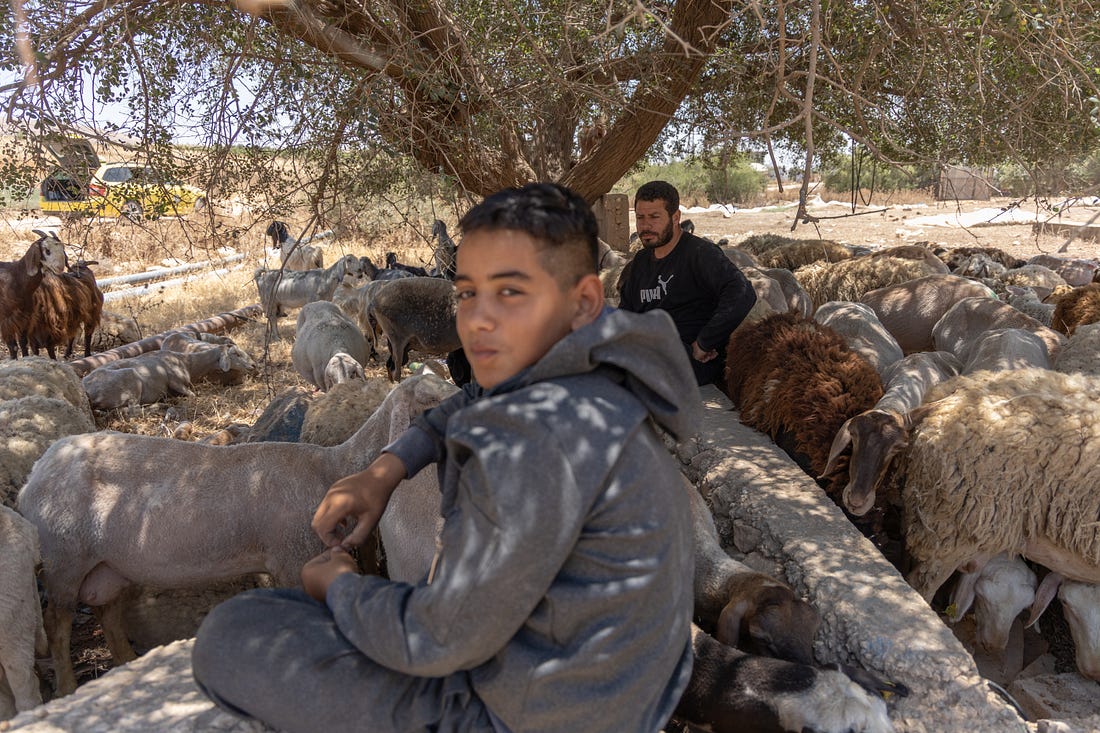
When the Yarza community called for help, Israeli soldiers did arrive—but not to defend them. “They supported them,” Daraghmeh said. “They considered the whole area a military training zone. When we would call because settlers were attacking us, the army would come and protect the settlers.” “[The settlers] kept harassing us, harassing us, harassing us, until they drove us out,” Daraghmeh continued. “They started stealing the livestock, stealing everything. They drove us out, and we left.” He and his former neighbors are now scattered across Tubas city, only a few kilometers from their homes, spending money on livestock they can no longer graze and generate little in return. Meanwhile, Bedouin communities further north in the Jordan Valley have seen some of the worst attacks. In the village of Humsa, 30 masked settlers arrived at a family’s home in the middle of the night, beat the entire family, sexually assaulted the father, and stole over 300 sheep, according to the Palestine News Network. Two volunteers from the International Solidarity Movement (ISM) were also beaten and had their passports and phones taken. An ISM volunteer, who asked not to be named out of fear that Israeli authorities would target them, has spent months doing overnight shifts with families across the valley. Palestinian communities request the volunteers, they said, just so they can sleep with some semblance of protection. “We call it solidarity presence and not protective presence,” the volunteer told Drop Site, “because being with the families doesn’t actually change much about what happens to the situation. We just serve as witnesses to settler violence or interactions with the military and police.” During one military raid the volunteer witnessed, soldiers conducted violent body searches on the men of a family while a woman collapsed on the floor, unable to breathe. Every time someone moved to help her, a gun was pointed at them and they were told to be silent. “Our presence here really does so little,” the volunteer said. “When 30 settlers come and you are two people, there is not very much you can do.” Redrawing the West BankIn 2025, the Israeli military launched a massive assault targeting the refugee camps of Jenin, Tulkarm, and Nur Shams in the northern West Bank. More than 30,000 Palestinians were displaced in the military operation and have been unable to return to their homes. Now, the focus has shifted to the eastern corridor. When complete, the Crimson Thread project will seal off the West Bank’s entire eastern side. “The Israeli strategy is to divide the towns in the north of the West Bank,” Khudeiri told Drop Site. “Tubas divided from Jenin. Nablus divided between Tubas, Nablus, and Jenin. The same with Tulkarm and Qalqilya. This is how they create what they call ‘containers.’” He continued, “Tubas, Nablus, Ramallah, Bethlehem, Silfit—all of these towns, they will be like huge refugee camps without any services, without any rights.” Khudeiri drove through the valley’s villages, ending the day in the small village of Bardala where he lives. He was explaining the area’s native flora when he abruptly stopped the car. There was a dead bird on the road. He moved it to the side, then stood there for a moment before returning to the car and driving slowly away. “They are trying to steal everything—the name of our plants, the song we use when our people harvest the wheat. We have a lot of things we don’t share anymore because they keep stealing more and more.” Become a Drop Site News Paid SubscriberA paid subscription gets you:✔️ 15% off Drop Site store ✔️ Access to our Discord, subscriber-only AMAs, chats, and invites to events, both virtual and IRL ✔️ Post comments and join the community ✔️ The knowledge you are supporting independent media making the lives of the powerful miserable You can also now find us on podcast platforms and on Facebook, Twitter, Bluesky, Telegram, and YouTube.
|





No comments:
Post a Comment
Note: Only a member of this blog may post a comment.