Leaked Documents: “Planned Community” in Rafah Would Force Palestinians Into Israeli PanopticonThe U.S.-led Civil-Military Coordination Center is proposing a residential zone in Gaza with biometric surveillance, checkpoints, and educational programs promoting normalization with Israel.
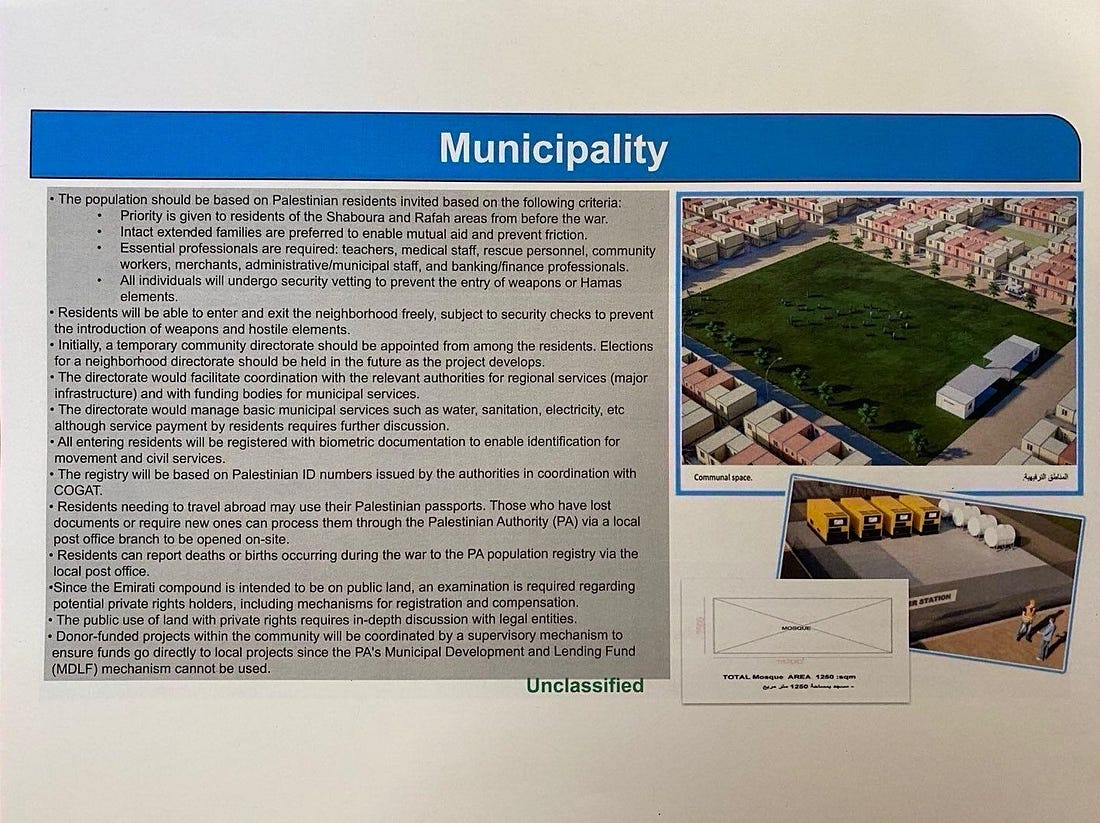
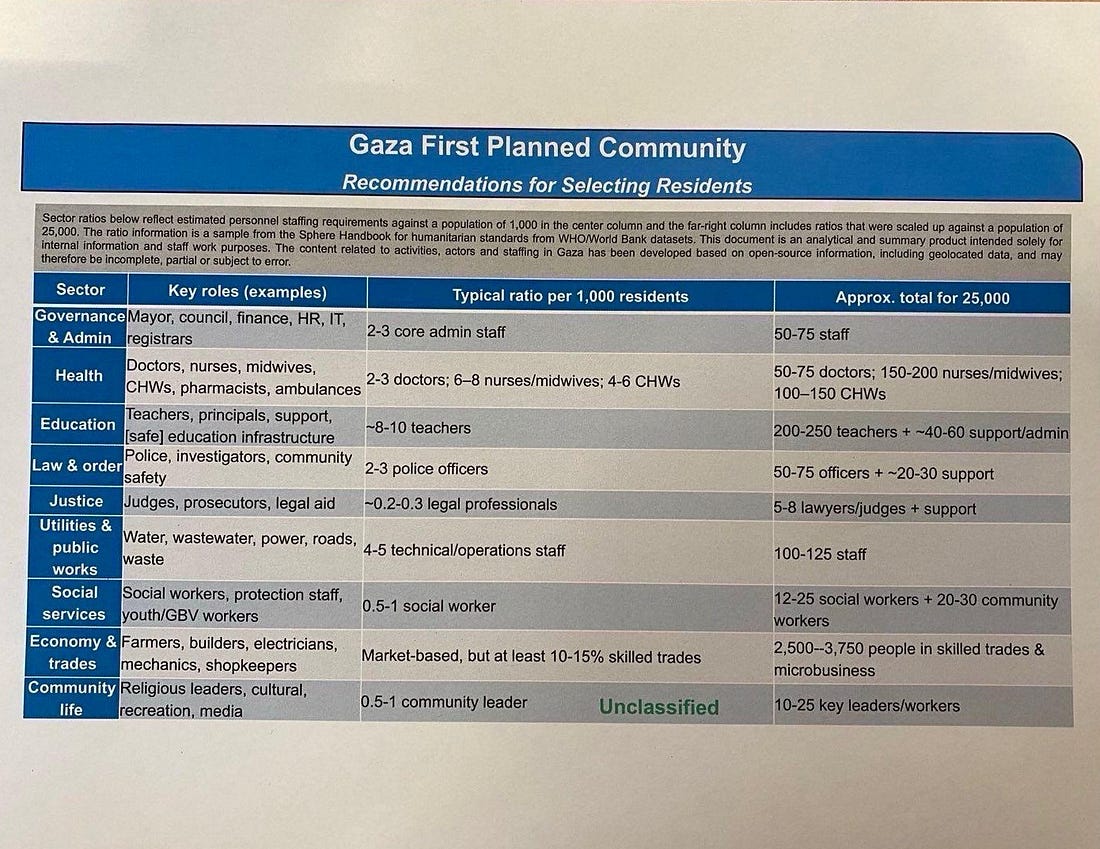
Drop Site is a reader-funded, independent news outlet. Without your support, we can’t operate. Please consider making a 501(c)(3) tax-deductible donation today.  The U.S. military-led group supporting “stabilization efforts” in Gaza has put forward plans for a housing block for Palestinians in Gaza in an area under full Israel military control. According to materials circulated by the Civil-Military Coordination Center (CMCC) and obtained by Drop Site News, the “planned community,” if developed, would contain and control its residents through biometric surveillance, checkpoints, monitoring of purchases, and educational programs promoting normalization with Israel. The CMCC was established by U.S. Central Command (CENTCOM) on October 17, one week after Hamas and Israel agreed to an exchange of captives and a ceasefire was supposed to go into effect. The center, which is based in a large warehouse-style building in Kiryat Gat in southern Israel and involves dozens of countries and organizations, is supposed to “monitor implementation of the ceasefire” and “help facilitate the flow of humanitarian, logistical, and security assistance from international counterparts into Gaza,” according to CENTCOM. The CMCC is led by U.S. Army Lieutenant General Patrick D. Frank and includes both U.S. and Israeli military officials along with personnel from dozens of countries, including France, Britain, Germany, the United Arab Emirates, and Egypt. The CMCC was a key feature of President Trump’s “ceasefire” plan, though it is unclear where exactly it will operate within the new structures being created after Trump announced Phase Two of the plan last week, including the formation of a so-called “Board of Peace” to oversee Gaza with a Founding Executive Board beneath it and a Gaza Executive Board of Palestinian technocrats beneath that. In November, news first emerged that the Trump administration was planning the construction of a number of residential compounds, dubbed “Alternative Safe Communities” to house Palestinians in Gaza east of the yellow line, an area occupied and controlled by the Israeli military. Analysis of satellite imagery by Forensic Architecture suggests the first of these so-called communities is being prepared on a 1-square-kilometer plot of land in Rafah in southern Gaza at the intersection of two military corridors. “Plans are rapidly accelerating for what U.S. officials last week cynically referred to as the ‘Gaza first planned community,’ previously known as ‘alternative safe communities,’” Jonathan Whittall, a senior UN official in Palestine between 2022 and 2025 and the executive Director of KEYS Initiative, a political affairs and strategic advisory organization, said after reviewing a transcript of the materials obtained by Drop Site. “This is the next phase in the weaponization of aid.” Last week, a presentation was given at CMCC headquarters about the “Gaza First Planned Community” that is being built to house up to 25,000 Palestinians. Palestinians would have to pass through a checkpoint to access the zone. “Residents will be able to enter and exit the neighborhood freely, subject to security checks to prevent the introduction of weapons and hostile elements,” the materials state. “All entering residents will be registered with biometric documentation to enable identification for movement and civil services.” “The registry will be based on Palestinian ID numbers issued by the authorities in coordination with COGAT,” a reference to the Coordinator of Government Activities in the Territories—the branch of the Israeli military that oversees Palestinian civilian affairs in the occupation of the West Bank and Gaza—giving the Israeli military even more surveillance control over Palestinians housed in the zone. CENTCOM directed inquiries from Drop Site about the CMCC’s plans to the White House, who in turn directed inquiries to the State Department. No one provided comment.
The presentation does not specify who would be selecting Palestinians to live in the zone, though all security checks for Palestinians in Gaza in the past (for example to be allowed to enter or exit the enclave) have ultimately gone through COGAT. It does, however, provide a set of criteria for deciding which Palestinians should be “invited” to live there:
As for Palestinians who may have lived there or have a legal claim to the land, the presentation notes that “an examination is required regarding potential private rights holders, including mechanisms for registration and compensation.” The promise of compensation to private land owners is striking in the face of the reality in Gaza after over two years of Israel’s genocidal assault, where most of the housing and civilian infrastructure in the enclave has been reduced to rubble, nearly the entire Palestinian population have been displaced from their homes, and Israeli troops occupy over half of the territory. The disparity between CMCC’s plans and Israel’s actions on the ground is reportedly leading several European countries to consider reducing their presence at the center or to stop sending personnel altogether, according to Reuters, citing concerns that CMCC has failed to increase the delivery of aid into Gaza. The proposed residential zone is referred to in the CMCC presentation as “the Emirati compound.” While it is unclear why that name was chosen, the Emirati field hospital, which is funded by the UAE, is nearby in Rafah. The UAE established formal relations with Israel in September 2020, as part of the Abraham Accords brokered by the first Trump administration that included other countries, including Bahrain, Morocco. Since then, the UAE has normalized relations with Israel more than any other Arab country, with robust trade, tourism, and defense cooperation. On Tuesday, the UAE accepted Trump’s invitation to join the “Board of Peace” that will oversee Gaza, becoming one of the first countries to do so. Part of the CMCC’s proposals regarding schooling in the planned residential zone seem aimed at promoting an Emirati-inspired reeducation program. It states that “Temporary ‘Emergency Studies’ can expedite a curriculum framework to resume classrooms. The curriculum will not be Hamas-based but will follow ‘Culture of Peace’ principles, e,g., modeled after the UAE.” The text of the normalization agreement between the UAE and Israel says both countries will “undertake to foster mutual understanding, respect, co-existence and a culture of peace between their societies.” The UAE embassy in Washington, D.C. did not respond to inquiries from Drop Site. The CMCC presentation also states that “educational programs can prevent diversion of an uneducated and unoccupied population to misaligned activities.” Despite Israel’s brutal occupation, Palestinians in Gaza and the West Bank have had one of the highest literacy rates in the world, reaching over 97 percent in 2020, with high rates of enrollment in secondary and higher education. The plan would also bring economic transactions under Israeli surveillance, replacing Gaza’s largely cash-based economy with “Electronic Shekel wallets” which would be used as “primary modes of commerce as they are secure and mitigate diversion of goods and funds to the Hamas financial channels.” The CMCC also proposes that “residents should be permitted to import products into the Gaza Strip to facilitate and encourage commerce and economic growth” but that “products would be subject to security restrictions and checks at crossings.” The presentation makes no mention of the fact that Israel, which controls all of the crossings into Gaza, has severely restricted the entry of goods for nearly 20 years. “This community being established in Rafah will form the blueprint for how Israeli control could be deepened and rolled out further,” Whittall told Drop Site. “After Gaza was razed, starved, and deliberately blockaded over the past years, these ‘new’ communities built on the rubble of peoples homes are not only governance labs to test ultimate control and subjugation, but they are also the reincarnation of refugee camps. They are designed to contain a new generation of dispossessed Palestinians, effectively screened and corralled into shrinking Israeli-controlled zones in exchange for survival. Meanwhile, the so-called ‘red-zones’ remain under assault, increasingly cut off from a humanitarian system that is being deliberately obstructed.” To enforce the CMCC’s restrictive vision, which would corral selected Palestinians into a zone where Israel and outside forces have complete economic, social, and security control, a police force would be installed that would operate under an international security force. “Civil policing will operate on-site to maintain public order, operating under the ISF,” the presentation states, referring to the International Stabilization Force that has yet to be formed but will be led by Major General Jasper Jeffries, the commander of U.S. Special Operations Command Central. The presentation adds, “Security-sector reform requires updated police and civil defense laws, strong oversight and accountability, people-centered security approaches, and measures to prevent radicalization.”
Text of the Presentation Delivered at the CMCC in Southern Israel on January 14, 2026Municipality
Economy
Health
Education
Justice: Law and Public Order
Become a Drop Site News Paid SubscriberA paid subscription gets you:✔️ 15% off Drop Site store ✔️ Access to our Discord, subscriber-only AMAs, chats, and invites to events, both virtual and IRL ✔️ Post comments and join the community ✔️ The knowledge you are supporting independent media making the lives of the powerful miserable You can also now find us on podcast platforms and on Facebook, Twitter, Bluesky, Telegram, and YouTube.
|

EXPERIENCE THE JOURNEY OF... KIM, TIM AND MOLLY MYERS AS THEY TRAVEL TO CHINA TO BRING HOME ANNIE!
Wednesday, January 21, 2026
Leaked Documents: “Planned Community” in Rafah Would Force Palestinians Into Israeli Panopticon




Subscribe to:
Post Comments (Atom)
No comments:
Post a Comment
Note: Only a member of this blog may post a comment.