

How a Squandered Democratic Trifecta Is Pushing Michigan LeftAnti-establishment candidates aim for a sweep across more than a dozen Michigan races in Tuesday's primary.
Polls close throughout most of Michigan at 8 p.m. ET tomorrow, and results in the closely watched race between Abdul El-Sayed and Rep. Haley Stevens will be coming in quickly. In Missouri, Cori Bush is locked in a rematch with Rep. Wesley Bell, who knocked her out of Congress with a then-record-setting amount of money from AIPAC. In Michigan and also in Washington state and Virginia there are a number of other critical races we’ll be watching. On Tuesday morning at 9:30 am ET, we’ll be hosting our regular livestream on YouTube and Twitter. Then on Tuesday evening at 7:30 pm ET we’ll go live with Krystal Ball at both the Drop Site and Breaking Points YouTube pages, and we’ll track the results until we have a winner. We’ll have a number of interesting guests coming through, though I don’t want to make any promises, because election nights can be chaotic. Tune in if you can. Either way, we’ll be watching a historic night unfold. As always, we can’t do this without your support. If you haven’t yet become a paying subscriber, please consider doing so. Or you can make a deductible contribution here. — Ryan Grim
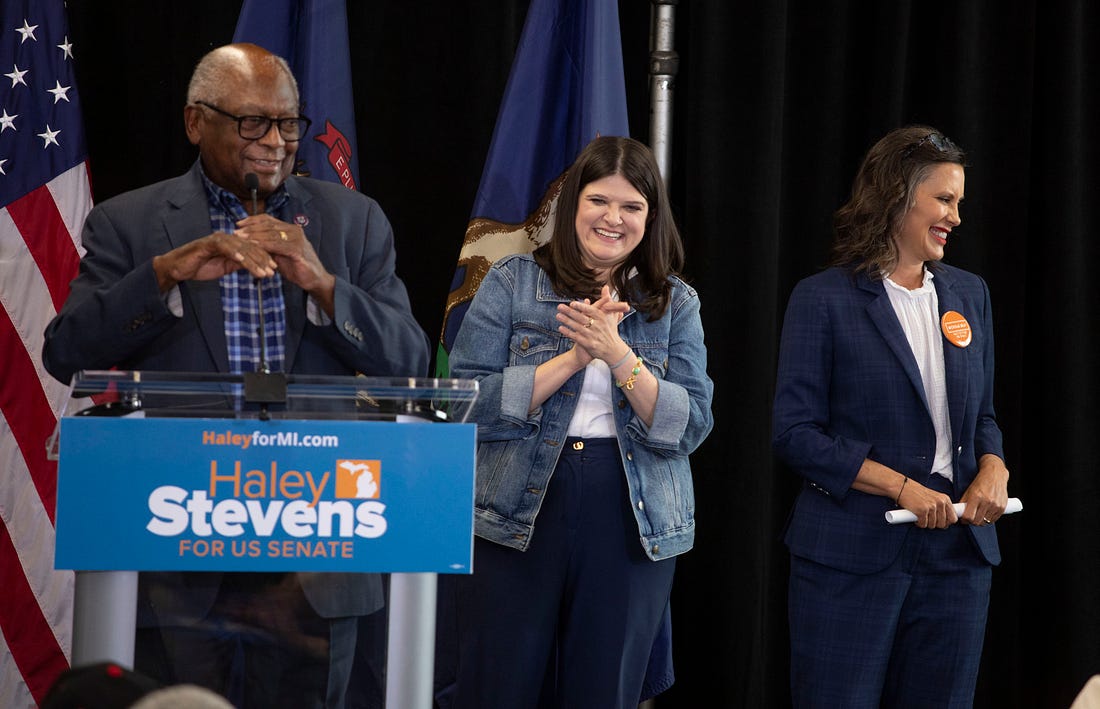
Story by Tom Perkins More than a dozen anti-establishment candidates running on populist economics and Israel policy are threatening to take seats now held by Democrats across Michigan, from U.S. Senate to city councils. A sweep or strong showing by these insurgents in Tuesday’s primary would be seismic, upending Democratic Party power dynamics in an establishment stronghold. More broadly, if the Democratic Tea Party comes for the bellwether state of Michigan, the results would show that a new bottom-up politics is taking root, providing the clearest signal yet that the fundamental shift in the party underway is not restricted to New York or heavily blue cities. (A full list of the races to watch on Tuesday, plus a handful already concluded, is at the end of this story.) To understand the moment here, one needs to look at the night of November 8, 2022, when midterm returns trickling in across Michigan slowly began to reveal a surprise result: Democrats had won a trifecta and gained control over the state government for the first time in 40 years. To many in the party, it felt like the state was emerging from the darkness after decades of being unable to legislate under one of the nation’s most gerrymandered maps, suffering under GOP governors like Rick Snyder, architect of the Flint water crisis. Rank-and-file Democrats expected that wildly popular proposals they supported would move easily into policy: making corporations pay for pollution, taxing the wealthy, dramatically expanding healthcare, addressing the soaring cost-of-living for the working class, and reining in DTE Energy, among the nation’s most expensive and unreliable utilities. These proposals did not pass. Most of the economic agenda died. No one was held responsible for Flint. Pro-business Democrats in leadership positions, including Gov. Gretchen Whitmer, thwarted the most meaningful proposals while cutting the Covid safety net. The largely squandered trifecta and failure to address Michigan’s most urgent economic needs infuriated the base. The party’s failures to enact popular legislation dovetailed with outrage over the establishment’s attacks on pro-Palestinian advocates and disrespect of Michigan’s huge Arab-American populations; centrist Democratic support for an onslaught of data center plans in the state; and the relentless prioritization of corporate interests over residents’ needs. The state’s powerful unions began inching away from corporate Democrats. This confluence of forces ignited the groundswell of support for the 15 grassroots change candidates now on the ballot. Some have already won this cycle, and the rest may make major gains on Tuesday. Yousef Rabhi is a Democratic Socialist of America (DSA) member aiming to unseat a 12-year party machine mayor in Ann Arbor, the state’s most liberal big city. He is up 13 points per a late July poll. “Ultimately a lot of the major landmark legislation that they promised just did not get delivered,” he told Drop Site. “Now there’s this combination of rank-and-file working people, progressive activists and folks from all over the political spectrum, people from Black, Arab, Jewish communities, who are feeling overlooked by Democratic party right now, and there is surge surge of left candidates where there is disaffection.” In the race for U.S. Senate, the latest polls put former Detroit health department director Abdul El-Sayed up by 10-15 points over Rep. Haley Stevens despite at least $30 million in spending by pro-Israel groups. The Bernie Sanders-endorsed, former Sunrise co-founder William Lawrence is up 15-25 points in a mid-Michigan U.S. House seat, though establishment polling has him behind. Donovan McKinney, backed by Justice Democrats and Sanders, was running slightly behind the AIPAC-backed incumbent Shri Thanedar in a poll on the Detroit U.S. House district race. Downballot, former Uncommitted Movement co-founder and Sanders endorsee Abbas Alawieh is attempting to be the first Arab-American to serve in the state senate, and to represent Dearborn, a city with a huge Lebanese-American population. Alawieh previously served as a congressional aide to Reps. Andy Levin and Rashida Tlaib of Michigan, as well as Cori Bush — who is mounting her own comeback bid in St. Louis on Tuesday. In a Detroit state house district, Chris Gilmer-Hill, backed by the DSA and Working Families Party, is running against State Rep. Helena Scott, a pugnacious machine politician. But the insurgents face headwinds. The congressional races are awash in corporate and pro-Israel lobby money. Pro-Israel donors are opposing leftist Yemeni-American state Senate candidate Abe Aiyash, and they account for about one-third of the $353,000 raised by his opponent, the establishment-backed Justin Onwenu. Meanwhile, many older, conservative black voters here have rejected Sanders-style politics, and division exists among them and Arab-Americans. The left has also been so weak in Michigan that there is little infrastructure like that which the DSA and Working Families Party laid for many years in New York that was essential to Zohran Mamdani’s win, and the June “socialist sweep.” Still, the Working Families Party and DSA are both gaining strength and active this cycle. And there may be an “Abdul effect,” said Bernie Porn, a state pollster with EPIC-MRA: “El-Sayed’s strength will probably translate into strength for all anti-establishment candidates.” Gaza and Economic Frustration DovetailThe Democratic trifecta culminated with an acrimonious intra-party lame duck fight at the end of 2024, as pro-business Democrat House Speaker Joe Tate sat on popular bills, including nine that passed the legislature. Among them, legislation to lower healthcare costs for unions, expand working class tax credits, address predatory debt collectors, and fund an African-American history museum. Democrats had lost the house in the November election, and instead of sending the bills to Whitmer for a signature before the trifecta ended, Tate handed them to incoming GOP leadership, which also refused to send them to the governor. The state supreme court, controlled by Democrats, ruled several weeks ago that the bills had to be sent to Whitmer for signatures. Instead, Whitmer quickly vetoed them. Labor viewed Whitmer’s move as a “betrayal,” a top official with one of the state’s largest unions, who declined to use their name to speak freely, told Drop Site. Michigan is a labor stronghold, but 50 years of establishment policies weakened it. Too many Democrats still try to “walk the line” between corporate and labor interests, the union official said. “When we took back the trifecta for the first time in 40 years, it was great that the party in charge shifted, but the reality is that the largest corporations in the state still were the ones who were setting the agenda at the governing table,” the union official added. Increasingly, the union has a hardline position, the official added: “You fight for workers or you do the bidding of corporations, but you cannot do both as Democrats have tried, and there’s a reckoning right now because of that.” However, there is no labor effort to support “leftist” candidates, the official said. Instead, they back candidates who unequivocally choose workers over corporate interests. In Michigan, that more frequently means candidates like El-Sayed, who also received a major endorsement from the American Federation of Teachers that is part of the AFL-CIO, and even a Wayne County Sheriff’s Office union. Rabhi, a union member who has joined others on the picket line, has support from the local teachers’ union that has never previously endorsed in a mayoral race, he said. Local chapters of AFSCME and the UAW have also endorsed him, as have the AFT and National Nurses’ Union, among others. This translates into material support on the ground. Earlier this year, in Three Rivers—the type of small, west Michigan town where El-Sayed needs to do well to win the nomination—he joined a UAW picket line. The union won an $8 per hour raise in a 10-day strike, and, in response, the union mobilized a door knocking campaign for El-Sayed, who won over some Trump voters there. The UAW also took a surprise step in voting to divest from Israel over its genocide, which drew retribution from the Trump administration. Meanwhile, economic discontent among Michigan’s Arab-American and Muslim communities added to frustration over establishment hostility to Arab-Americans and pro-Palestinian advocates. The establishment ignored the 100,000 “uncommitted votes” in Michigan’s 2024 Democratic presidential primary, and steadfastly refused to change course on its support for Israel’s genocide. Though no data on how many uncommitted voters did not vote for Kamala Harris in the general exists, she lost the state by 80,000 votes, and election data showed a loss of about 22,000 votes in the three cities with the highest Arab-American and Muslim populations alone. It appears the establishment learned little. It launched attacks in late March against El-Sayed for campaigning with Hasan Piker, broadly over their criticisms of Israel. The media attacks, led by State Sen. Mallory McMorrow, then El-Sayed’s opponent, came as Israel was invading Lebanon, and destroying cities in which many local Lebanese-Americans have roots, family members, and friends. Some community leaders warned that the Democratic establishment was ignoring their pain, and making the same mistakes as 2024. Weeks later, Gaza and economic discontent drove upsets at a contentious April Democratic nominating convention, where leftist, pro-Palestinian attorney Amir Makled beat the pro-Israel, establishment candidate Jordan Acker for University of Michigan regent. Acker had led the U-M attack on pro-Palestinian students. And Eli Savit, a progressive prosecutor, defeated the corporate, pro-Israel-backed Karen MacDonald for the state attorney general. Within months of the Piker controversy, McMorrow dropped out as she lagged in the polls, and El-Sayed broke out as the front runner. The economic frustration is not separate from dismay over establishment support for Israel for Arab-American and Muslim voters here, and Gaza is many issues wrapped into one, said Bilal Baydoun, a political analyst in Dearborn. “Supporting the genocide in Gaza is a statement on where Democratic priorities are and it’s an identifier where people say ‘Look they’re sending billions of dollars to Israel, and I haven’t heard of anything they’re doing for my kids,’” Baydoun said. “People say ‘I was able to afford a home in my country—I don’t think my kid can do that anymore.’” A survey conducted in April, sponsored by Drop Site News and Zeteo, found that 62% of Michigan Democratic primary voters agreed that they are less likely to trust a candidate would stand up for Michiganders in general if they won’t stand up to AIPAC; 13% disagreed with this sentiment. Can Anti-Establishment Candidates Win in Detroit and Ann Arbor?In Ann Arbor, where Rabhi and a slate of four other candidates are attempting to put a major dent in the corporate political machine that has ruled for 12 years, voters’ concerns are a microcosm of the state and federal levels. “People say that for 12 years the rent has gone up, the cost of living has gone up, the roads have fallen apart, and city services have not been meeting the needs of the residents,” Rabhi said. But Michigan is a diverse state and though the 15 candidates generally support the same policies, campaigning on the east side of Ann Arbor may look different than on the east of Detroit. One recent poll shows El-Sayed behind in Detroit 66-33. Part of this may be the conservative older population. And tensions exist between Black people and Arab-Americans in Detroit, which in part stems from anger with gas station, party store, and grocery store owners in the city who are largely Chaldean and are accused of mistreating their mostly Black customers. Some, like Eboni Taylor, a Sanders endorsee running for in a state Senate district on Detroit’s largely Black east side, actively avoid the “leftist” label, and make clear they do not have an association with the DSA. While campaigning, Taylor talks about maternal health, bringing down childcare costs, and rejecting corporate money because “these are common sense things that people want,” Taylor said. “Working class families are waiting their turn to be heard and for policy to work for them, and that’s what is resonating for them with my campaign.” When she navigates nursing homes or other areas where her list of progressive endorsements does not carry a lot of currency, she connects with people by talking about her history in the Baptist church, struggles raising kids, and watching her working class parents who still live in the same east side home build a better life for her. However, Detroit City Council Member Denzel McCampbell, a former spokesperson for Rep. Rashida Tlaib, openly campaigned and won this cycle as a DSA member in a largely Black, low-income district on Detroit’s west side, and survived his opponents attacking him for being socialist. “On the doors, what it meant to be a socialist did not come up - what came up is ‘You’re not going to sell us out, right?’” McCampbell said. “That’s what’s connecting—‘Are you going to be an authentic leader that fights for us?’” Key Michigan races:
Become a Drop Site News Paid SubscriberA paid subscription gets you:✔️ 15% off Drop Site store ✔️ Access to our Discord, subscriber-only AMAs, chats, and invites to events, both virtual and IRL ✔️ Post comments and join the community ✔️ The knowledge you are supporting independent media making the lives of the powerful miserable You can also now find us on podcast platforms and on Facebook, Twitter, Bluesky, Telegram, and YouTube.
|





No comments:
Post a Comment
Note: Only a member of this blog may post a comment.