

Massive Israeli Assault on Lebanon Threatens U.S.-Iran CeasefireOver 250 people were killed in what the Israeli military said was the “largest coordinated strike” on Lebanon since March 2.
Drop Site is a reader-funded, independent news outlet. Without your support, we can’t operate. Please consider becoming a paid subscriber or making a 501(c)(3) tax-deductible donation today.
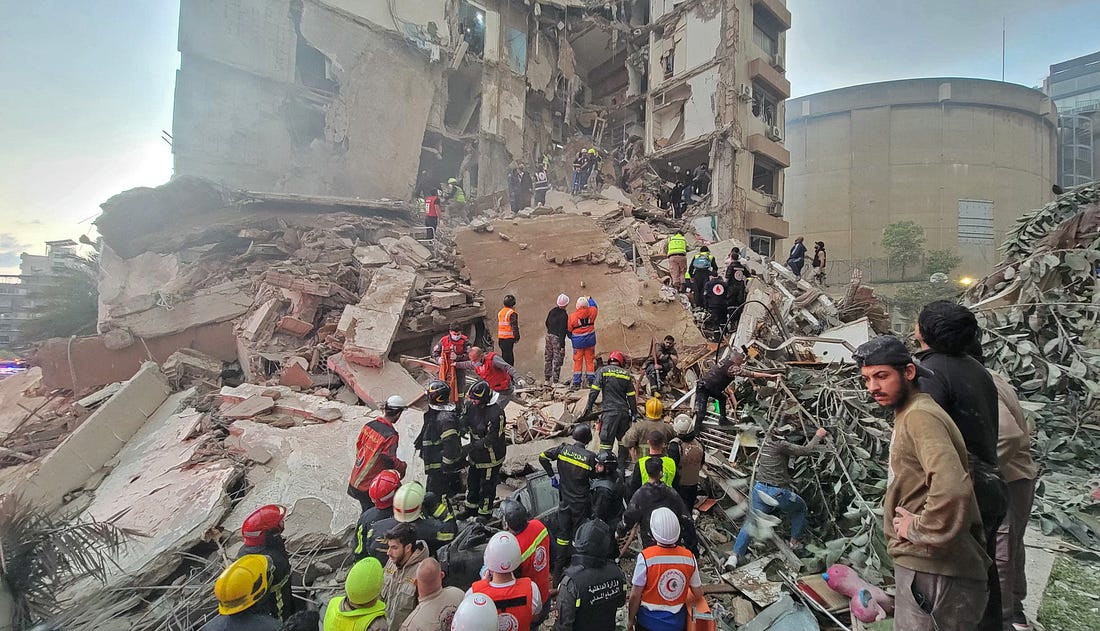
BEIRUT, Lebanon—At 2:15 p.m. on Wednesday afternoon, Dalia, 38, was at a gym down the street from her home in the Karakas neighborhood in central Beirut when a series of massive airstrikes rocked the city. One of the strikes hit just up the street, along the stretch of road between her apartment and the gym—a route she walks every day. The blast was so forceful it shook the building and left her ears ringing for hours. Her first thought was her daughter, who was at a basketball court across the street. When Dalia ran outside, she immediately saw thick smoke rising in the air. She sprinted to the court and found her daughter crying alongside other children. “All the children were traumatized,” she said. The strikes were part of a sweeping Israeli aerial bombardment campaign across Lebanon on Wednesday that came just hours after a U.S.-Iran ceasefire agreement was announced by President Donald Trump. In a span of 10 minutes, Israel hit over 100 targets across the country, including many in densely populated neighborhoods of Beirut and its southern suburbs. According to Lebanon’s Civil Defense, at least 254 people were killed and over 1,100 wounded in the attacks. The vast majority of the casualties were in the capital and its southern suburbs, with over 150 killed. The Israeli assault came without warning and was by far the heaviest single wave of attacks on Lebanon over the past five weeks. In Beirut, the speed and scale of the bombardment stunned a population that has experienced successive wars, but rarely like this: strikes landing almost simultaneously, in broad daylight, while the streets were crowded. Thick black smoke billowed across the city as the sound of ambulances echoed through the streets. Authorities urged residents to remain indoors to allow emergency responders to move through the traffic-clogged roads. Dalia said the shock has yet to settle. “It’s surreal,” she said. “Did this really happen? Was it really this close to home? I really don’t think I’ve processed it yet.” Hours after its initial spate of airstrikes, the Israeli military bombed a nine-story residential building in Beirut’s Tallet al-Khayyat neighborhood, trapping residents under the rubble. Outside of Beirut, at least ten people were killed during a funeral in the town of Shmustar in eastern Lebanon. Three girls were killed in Adloun, a coastal area in the south. A family of four was killed in the northeastern village of Mansoura. Four people were killed in a strike on the southeastern town of Majadel. Lebanon’s Health Minister Rakan Nassereddine told Al Jazeera that, “Hospitals are overcrowded with martyrs and the wounded.” Hospitals across Beirut quickly issued urgent calls for blood donations. At St. George Hospital in Geitawi, a nurse hurriedly organized donors in the blood bank, urging those with type O blood to come forward. In the hospital’s lobby and courtyard, people clutched their phones, some sobbing as a drone buzzed overhead. Israeli Prime Minister Benjamin Netanyahu said on Wednesday that the “temporary ceasefire” with Iran would not include Lebanon, “and we are continuing to strike it with force.” The Israeli military bragged about what it said was the “largest coordinated strike” on Lebanon since the start of “Operation Roaring Lion” on March 2, with targets struck in Beirut, the Beqaa Valley, and southern Lebanon. It published multiple posts online, including a graphic depicting the locations of the bombings across the country, photos of the aircraft that allegedly took part in the attacks, and photos of the Army Chief of Staff Lieutenant General Eyal Zamir alongside senior military officials supposedly in an operations room at the time of the strikes. “We will not compromise the security of the residents of northern Israel. We will continue to strike with determination,” Zamir was quoted as saying. The attacks came just hours after the ceasefire was announced for the Iran war, which included Lebanon, and threatened to unravel the agreement on day one. President Donald Trump claimed in response to questions from PBS that Lebanon was “not included in the deal,” calling it a “separate skirmish.” White House Press Secretary Karoline Leavitt later reiterated the claim at a White House press briefing, saying, “Lebanon is not part of the ceasefire, that has been relayed to all parties involved in the ceasefire.” In response, Iranian foreign minister Abbas Araghchi reposted the original statement from Pakistani Prime Minister Shehbaz Sharif announcing the ceasefire and highlighted the text of the agreement that stipulated an “immediate ceasefire everywhere including Lebanon.” Araghchi wrote, “The Iran–U.S. Ceasefire terms are clear and explicit: the U.S. must choose—ceasefire or continued war via Israel. It cannot have both. The world sees the massacres in Lebanon. The ball is in the U.S. court, and the world is watching whether it will act on its commitments.” Iran’s speaker of parliament Mohammad-Bagher Ghalibaf also posted a statement outlining what it said were violations of key clauses of the agreement framework, including “non-compliance with the first clause of the 10-Point Proposal regarding the ceasefire in Lebanon.” Niku Jafarnia, a Beirut-based lawyer and researcher with Human Rights Watch, said the attacks hit densely populated areas without warning. “Under the laws of war, parties to a conflict must take all feasible precautions to avoid or minimize the incidental loss of civilian life,” she told Drop Site. Striking “within the heart of the civilian population shows a callous disregard for the civilians living in these areas.”
Become a Drop Site News Paid SubscriberA paid subscription gets you:✔️ 15% off Drop Site store ✔️ Access to our Discord, subscriber-only AMAs, chats, and invites to events, both virtual and IRL ✔️ Post comments and join the community ✔️ The knowledge you are supporting independent media making the lives of the powerful miserable You can also now find us on podcast platforms and on Facebook, Twitter, Bluesky, Telegram, and YouTube.
|




No comments:
Post a Comment
Note: Only a member of this blog may post a comment.